
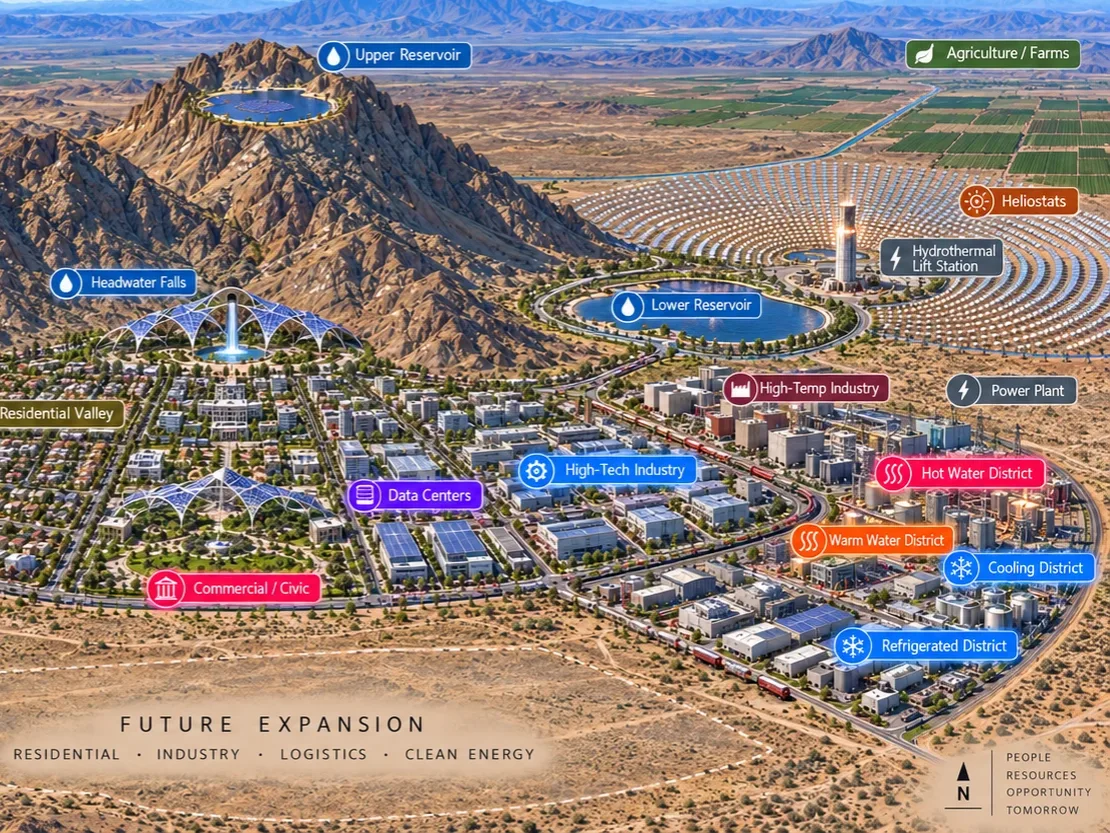
GigaTown South concept aerial around mountain water storage, with farms, homes, water treatment, compute, industry, solar fields, and transport links Regional concept · South

GigaTown South · current planning basis

Make water do more work.

A hot-region planning model connecting irrigated agriculture, water services, a single-collector solar-lift study, six-unit gravitational storage, compute, thermal services, land, housing, and public institutions.

ProposedModeledSites and rights under evaluation

The concept broadly reflects the current regional package. It is not a selected site plan; embedded labels do not establish final geometry, ownership, rights, or procurement.

The regional proposition

Begin with agriculture and water—not an industrial campus.

GigaTown South starts with irrigated agriculture, water delivery, solar resources, mountain-storage potential, desert heat, and the need for a public bargain that keeps government separate from the private developer.

The model asks whether infrastructure serving farms and towns can also support energy storage, compute, thermal services, and phased development—without casually competing for scarce water or blurring public authority.

Water rights, reservoirs, generation choices, service agreements, sites, tariffs, public formation, and financing remain subject to evaluation and approval.

South system architecture

Water, energy, elevation, and demand work as a coordinated system.

Physical services connect through measured interfaces. Private companies remain separate from the proposed Public District.

Isolation is part of the design.Compute coolant and irrigation water do not mix. Energy may cross an isolated exchanger, while monitoring, blending, and alternate heat rejection protect farm service and industrial operation.

How the model creates value

A water-and-storage economy.

  1. Agriculture is the starting point.The project must strengthen water delivery and farm economics rather than treat farmland as empty industrial real estate.
  2. Water infrastructure becomes regional infrastructure.Canal improvements, delivery, treatment, storage, reclamation, and municipal services require explicit agreements and rights.
  3. Solar resources and elevation complement one another.PowerCo’s current planning package studies one 1,500-acre collector/receiver field driving two mechanical pump trains, plus six reversible hydro units. Optical fit, rights, equipment, and performance remain to be established.
  4. Compute provides an anchor market.Large continuous demand can support power, water, cooling, and enabling infrastructure at regional scale.
  5. HeatCo creates an additional farm service.Across isolated exchangers, irrigation water already headed to participating farms may accept a verified modest temperature lift.
  6. Land and public infrastructure grow in phases.Private development companies and a separate public-purpose entity retain distinct assets and responsibilities.

Farmer partnership · cross-company program

Keep farming. Add a measured infrastructure service.

Participating growers could receive agreed irrigation service, modernized shared infrastructure, contractual maintenance savings, payment for accepting modestly warmer water, and additional income for verified conservation—without reducing agricultural production.

Separate fluids

Compute coolant and irrigation water remain isolated across heat exchangers.

Measured crop protection

Temperature is measured at delivery and crop application, with blending and alternate rejection available when conditions do not fit.

Voluntary participation

Service enrollment, conservation payments, and any water transfer depend on verified agreements with growers, rights holders, districts, and public authorities.

No separate agricultural company is proposed for South.This is a coordinated program involving HeatCo, WaterCo, public administration, districts, and participating growers.

Accountable operators

Five proposed companies. One separate public entity.

GigaTown Development

Proposed system integrator

Coordinate the whole delivery system without pretending to own all of it.

Development coordinates land and corridor control, enabling works, delivery sequencing, construction management, anchor and government engagement, and interfaces among the private companies and Public District. It is not the town government or every operating utility.

LandCo

Proposed estate company

Grow the town in phases while preserving long-term alignment.

LandCo assembles land, develops shared civil infrastructure to parcel boundaries, releases residential sites in stages, and may retain selected compute, industrial, commercial, and solar sites for ground rent. Sites and acquisition structures are not yet final.

PowerCo

Proposed energy business

Turn variable generation and elevation into dependable energy service.

PowerCo separates generation and storage from supply and distribution. Its current planning package includes an upper reservoir, incremental hydro works, six reversible units, a single-collector mechanical solar lift, reservoir floating PV, modeled gas/steam generation, grid supply, town distribution, customer service, and exports. These are planning studies—not selected sites, reservoir rights, OEM commitments, or a promised 24/7 clean-power product.

GigaTown Water Services

Proposed water-services boundary

Improve the productivity and resilience of the regional water system.

WaterCo’s modeled scope includes bulk delivery, selected canal improvements, allocated canal solar, treatment, drinking water, wastewater, reclamation, and municipal service availability. Every service depends on applicable rights, agreements, regulation, and final allocation.

GigaTown Thermal Energy

Proposed thermal utility

Sell reliable cooling first. Recover useful heat where the fit is real.

HeatCo sells compute cooling and hot-side heat removal, maintains dry and emergency wet rejection, and evaluates qualified agricultural, district, hot-water, refrigeration, and industrial uses. None of those customers replaces required rejection.

Public District

Proposed separate public-purpose entity

Public value with public accountability.

The proposed district provides a separate boundary for public works, civic assets, administration, public-service contracting, and eventual accountable operation. The concept anticipates published budgets and contracts, open records, service standards, asset handover, and elections where applicable.

The planning model does not create a municipality, approve taxes, commit public funding, or make the district a subsidiary of a private company.

Continue exploring

South applies the method to a different resource map.

Compare it with a northern system organized around firm power, useful heat, controlled-environment agriculture, and winter public life.