Physical
Energy, heat, water, land, logistics, and buildings must connect at the right grade, location, timing, and reliability.

How GigaTown works
Energy plants, data centers, greenhouses, reservoirs, homes, and public institutions already exist. GigaTown arranges their commercial, physical, and civic interfaces so each can make the others more valuable.
Three architectures
Energy, heat, water, land, logistics, and buildings must connect at the right grade, location, timing, and reliability.
Every asset needs an accountable owner, customer, tariff or funding path, operating duty, and allocation of risk.
The host community helps shape public boundaries, service expectations, local participation, and durable shared value.

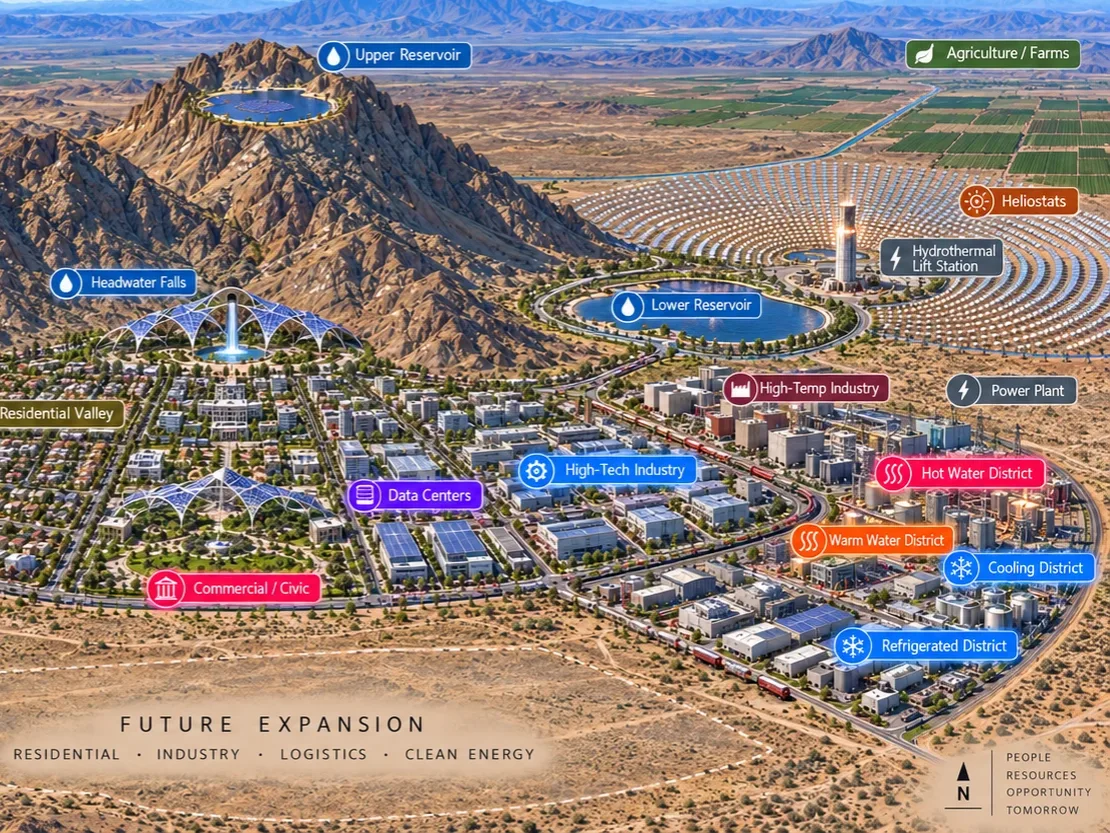
Portfolio system
This is not a one-way chain. Community priorities and productive demand change what infrastructure should be built; operating data and resource limits change how the region grows.
The resource cascade
A useful output is not automatically a useful input. Temperature, pressure, chemistry, distance, timing, reliability, regulation, and cost determine whether a connection is real.
Low-temperature recovered heat can serve greenhouses, warm-water networks, or efficient buildings. It should not be credited as though it can perform high-temperature industrial work without an additional energy source.
Water systems remain isolated where public health, crop protection, operations, or regulation require it. An exchanger can transfer energy without mixing fluids.
Beneficial users are customers, not required safety infrastructure. A thermal utility must still reject heat independently when a greenhouse, public pool, or industrial customer is unavailable.
Designed boundaries
Clear interfaces make a connected system governable.
Each regional company, cooperative, utility, or public entity receives explicit assets, customers, meters, operating duties, and risks. Physical loops can exchange energy while remaining separated. Private development and public administration remain distinct.
The civic operating system
Housing supply, public services, local enterprise, agricultural continuity, public assets, utility quality, construction impacts, and governance are not side effects to address after the engineering is finished.
They are inputs that shape phasing, ownership, corridors, tariffs, service agreements, and the public bargain.
“The community should be stronger because we are here.”
Regional adaptation
North begins with cold, firm power, useful heat, and winter agriculture. South begins with irrigation, solar resources, elevation, water resilience, and a separate public district.