GigaTown South

Productive farms. Water conserved.
Abundant sun put to work.

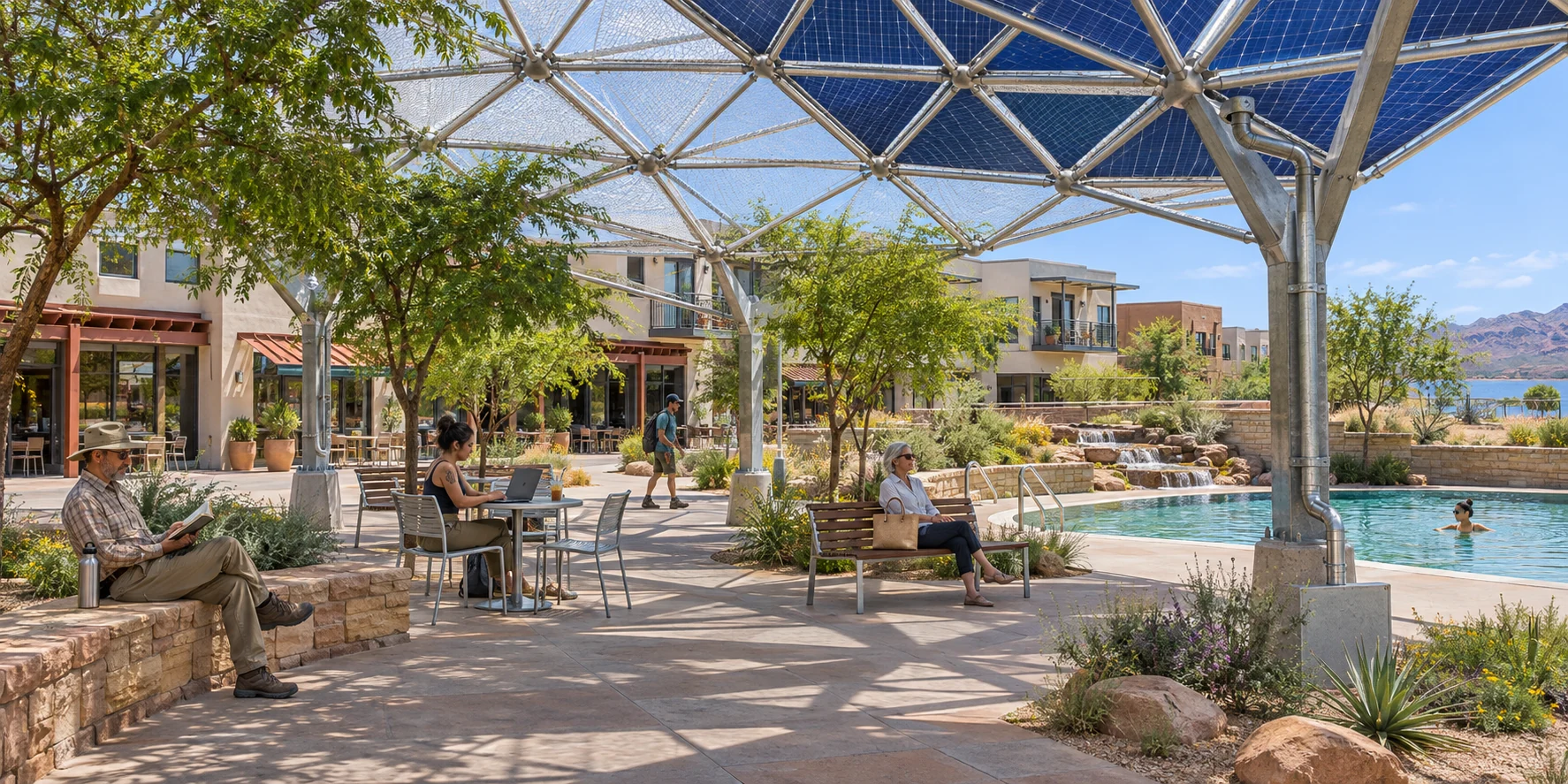
A solar space-frame canopy shades a Southwest civic plaza, with seating, shops and a protected swimming lagoon.
Solar shade · A public place for hot days

Less pressure on water.
More opportunity for the region.

Hot summers make cooling expensive. Farms face water pressure. New industry needs infrastructure, workers need homes, and communities need jobs that last beyond construction. South starts with the region’s existing agriculture and abundant sun: conserve water while keeping land productive, use scheduled irrigation to help cool compute, and put solar power to work for farms, homes and industry.

Farmers gain paid cooling work, better irrigation and income from verified conservation. Greenhouses and local processing keep land productive and more value in the harvest. Stored solar and useful heat support local industry. Add homes, shared ownership and solar-shaded civic spaces, and the data center becomes part of a lasting regional economy.

A proposed regional model. Site, water rights, engineering, partners, service terms and public approvals remain to be established.

Explore how it works

What does this mean for you?

Choose an organization to see its job, its connections and how you can participate. The Public District is a separate public body.

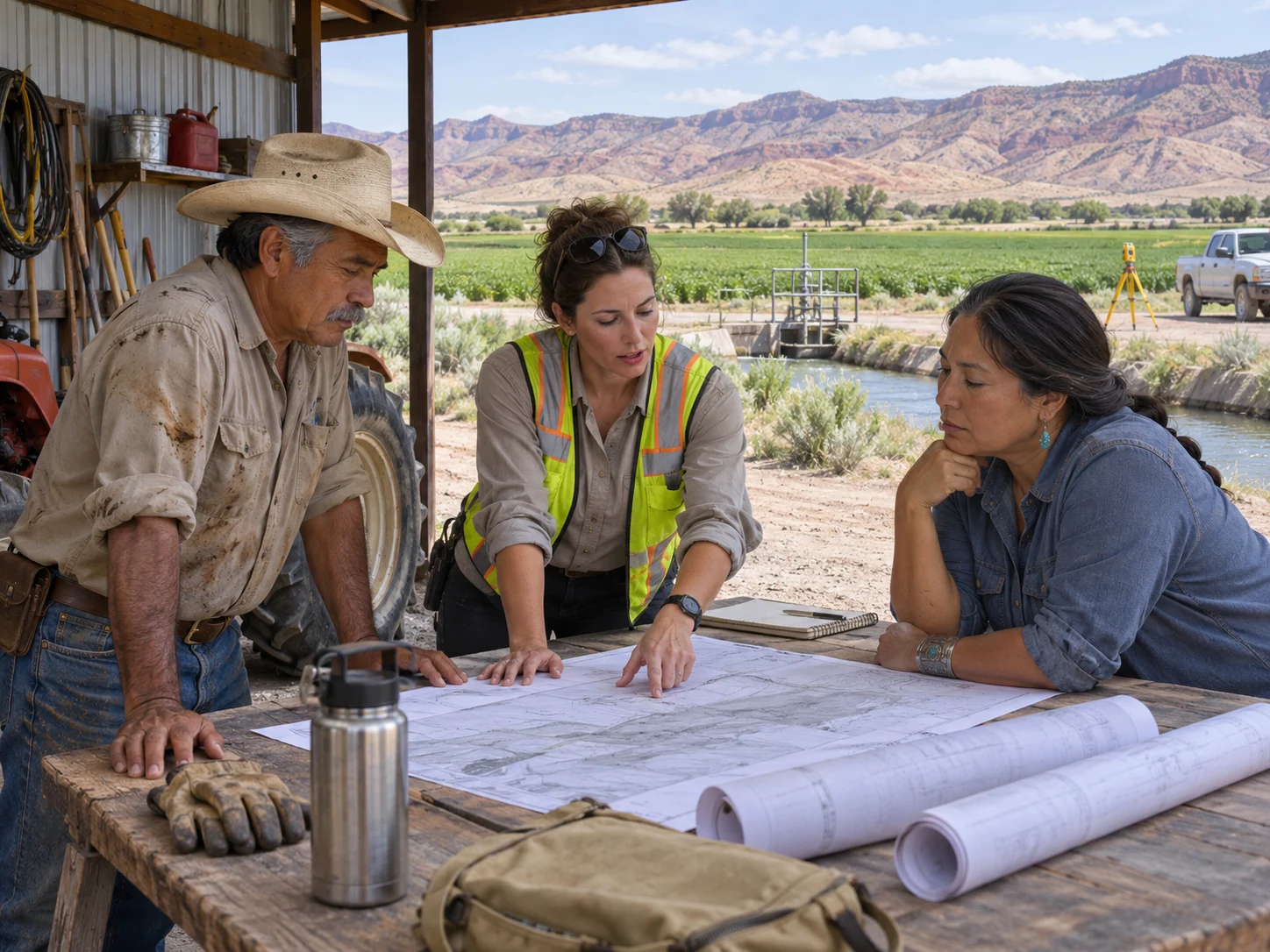
Farmers, an engineer and a community representative review drawings beside productive fields and an irrigation canal.
Plan with the people already working here.

Development · Bring the regional system together

Plan the infrastructure and the public bargain together.

Development brings farmers, the host community, the compute anchor and the operating companies into one delivery plan. Water, power, cooling, industry and housing need to be ready for one another.

Start with working farms.

Agree the irrigation partnership and conservation program before committing the town to water it does not yet have. Match conditional land and corridor access to actual utility capacity, customer commitments and public requirements.

Put investment behind the connections.

The anchor’s demand can help finance enabling infrastructure. Negotiate capacity commitments, contributions and financing with the customers who benefit, then assign each asset and obligation to its owner. Construction management coordinates delivery; it does not turn Development into the utility or government.

A practical role for local partners.

Farmers help set operating conditions. Builders, manufacturers and local businesses bring real sites, products and demand. Residents and public authorities help shape housing, service standards and civic priorities before the major decisions are locked.

Prove the partnership, then grow. Begin with a workable pilot. Add neighborhoods, industrial tenants and services when water, operating performance, funding and demand support the next phase.

Responsibilities and planning basis

The launch proposal separates agreed canal works, agricultural-program administration, municipal water access and the battery’s purchased fill. Funding improvements does not itself transfer water rights or authorize a project.

Role
Proposed integrated development and construction-management boundary.
Owns or operates
Conditional land/corridor control, enabling-work coordination, delivery sequencing, construction management, anchor/state engagement, and cross-company delivery coordination as contracted.
Receives
Partner commitments, capacity agreements, development funding, and requirements from the host jurisdiction and operating companies.
Provides
A coordinated delivery plan and accountable interfaces among private companies, anchor customers, farmers, and the Public District.
Community value
Prevents fragmented infrastructure delivery and creates a single place to negotiate sequencing and enforce the regional bargain without making the developer the government.
Key interfaces
LandCo, PowerCo, WaterCo, HeatCo, compute and industrial anchors, farmers, the host jurisdiction and the separate Public District.
Status and open questions
Proposed boundary; exact sponsor, legal structure, contracts, site, and approval path remain unresolved.
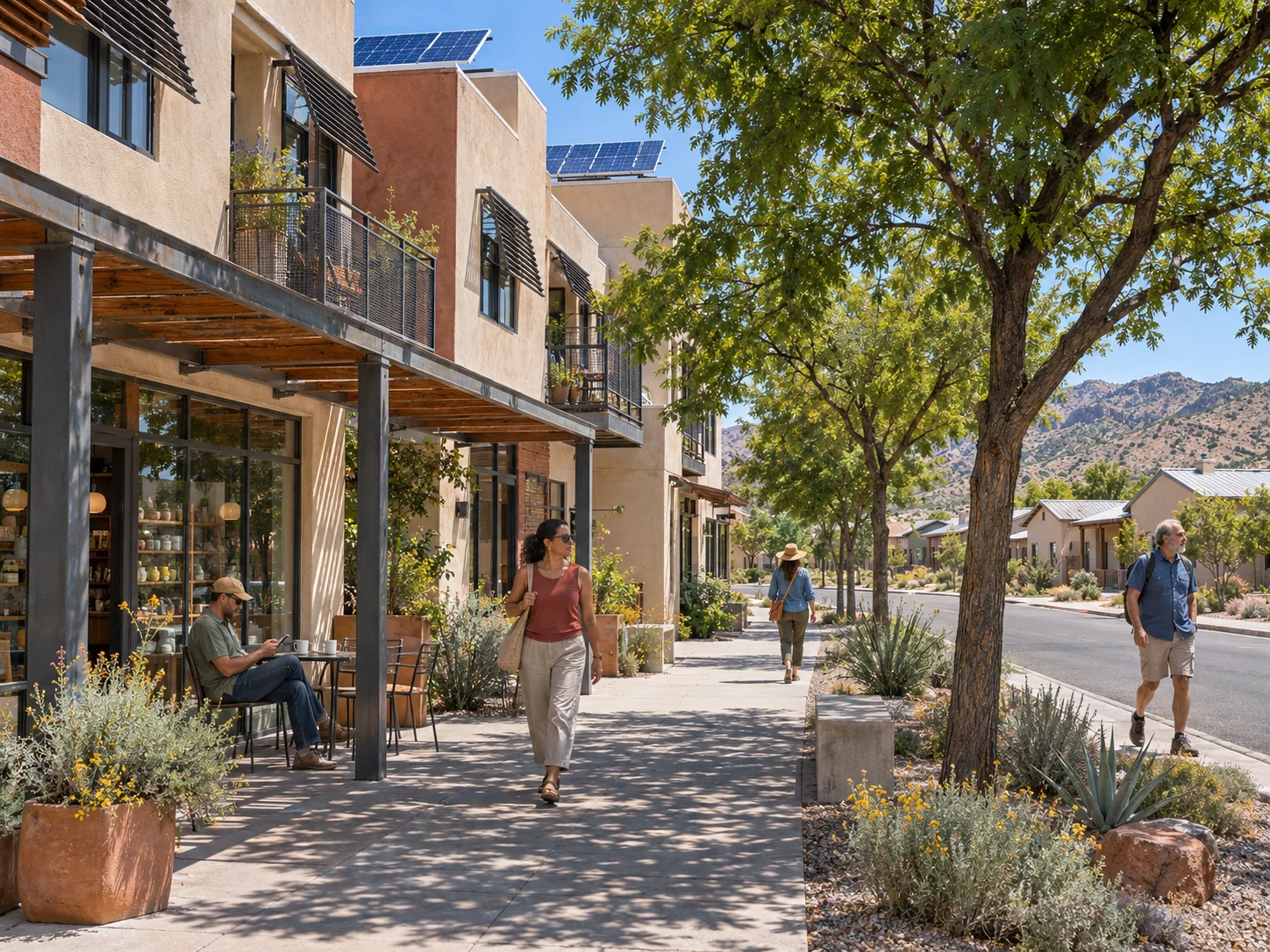
A walkable Southwest neighborhood with apartments above independent shops, roof solar and shaded sidewalks.
Homes and businesses alongside the jobs.

LandCo · Land, homes and places to work

Turn serviced land into a place to build a life.

LandCo assembles land, delivers common roads and service access, and releases housing sites as jobs and utilities arrive. It retains suitable business and industrial sites on long-term ground leases.

Add homes with the employment.

Permanent apartments and neighborhoods give workers somewhere to settle. Phasing homes with commissioned services aims to keep growth from piling housing pressure onto nearby towns. Affordability has to work against local wages and the full cost of living.

Give local businesses room to grow.

Serviced plots connect manufacturers, food processors, shops and hospitality businesses to customers and infrastructure. Builders construct the homes; business tenants build and operate their premises. LandCo provides the land and agreed site readiness.

Clear terms for builders and tenants.

Parcel releases, ground leases, neighborhood covenants and utility responsibilities need explicit prices and obligations. Utility companies fund their allocated systems. Public streets and civic assets transfer only through agreed acceptance and funding.

Responsibilities and planning basis

Current estate figures are development scenarios, not a selected footprint, finished-home price or guaranteed return. The latest financial reference removes the older land package’s nuclear reservation and revises public contributions. Residential sites and permanent housing remain distinct from temporary construction accommodation.

Role
Proposed long-term land-development and estate company.
Owns or operates
Land assembly, common civil infrastructure to parcel boundaries, phased residential releases, serviced sites, and retained ground leases.
Receives
Land and corridor agreements, ground rent, parcel receipts, and infrastructure requirements from utilities and the public plan.
Provides
Phased housing and employment sites, long-term industrial/compute/commercial leases, and coordinated land availability.
Community value
Connects infrastructure growth to housing and serviced land rather than leaving an isolated industrial campus.
Key interfaces
Development, utilities, builders, compute and industrial tenants, residents and the Public District.
Status and open questions
Current planning package; site, title, absorption, utility, builder, and public-plan assumptions require validation.
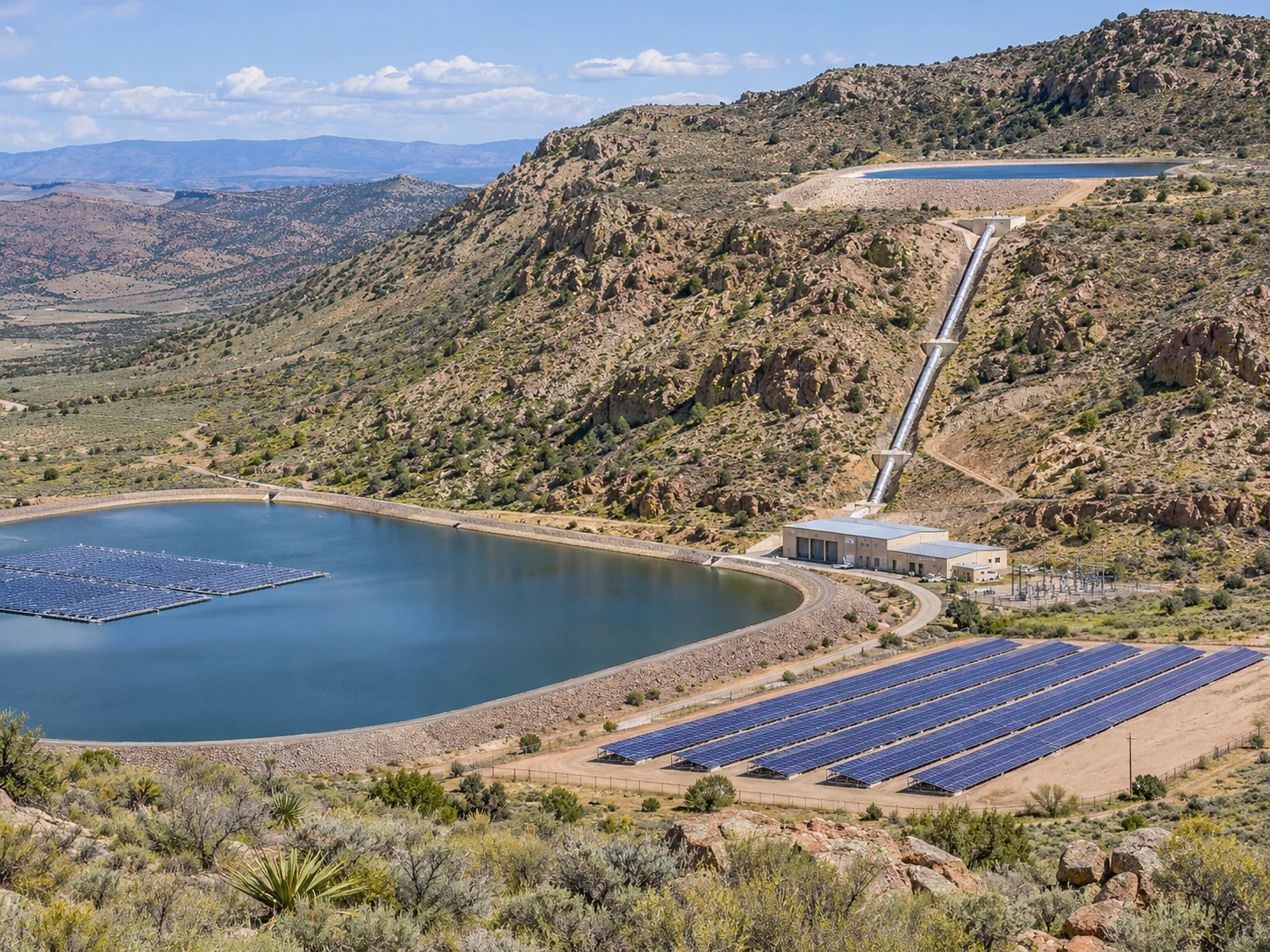
An upper reservoir on rocky Southwest foothills sits above a larger lower basin, with a powerhouse, penstock corridor and solar generation.
Store energy in elevation. Share water infrastructure carefully.

PowerCo · Solar, storage and dependable supply

Put the sun to work when people need the power.

PowerCo connects abundant solar with the compute campus, homes and industry. It combines solar and grid supply, generation, storage and distribution so a sunny afternoon can support demand later in the day.

Roofs and parking lots first.

Put civic rooftops, parking canopies and the data-center roof to work while keeping farms productive. Centralized cooling makes more of the compute roof available for panels. Coordinate with WaterCo’s canal-cover solar, which adds generation and shade to reduce evaporation. Ownership and supply agreements keep each installation’s responsibilities clear.

The mountain battery.

When power is economical, pumps move water from the common lower reservoir to an upper reservoir. Later, water returns through hydro turbines to make electricity. The same stored inventory circulates; purchased initial fill and replacement for actual losses have separate water accounts.

One lower basin, several obligations.

The Public District owns the common lower regulating reservoir, and WaterCo operates it under contract. PowerCo owns the upper reservoir and incremental hydro works. Operating levels must protect municipal and agricultural allocations while preserving usable storage—not treat every acre-foot as freely available for power.

Reliable supply takes a portfolio.

The current study also includes reservoir floating solar and a gas-fired boiler/steam plant. Dispatch buys or generates power for immediate use and stores it when later value covers losses and costs. Contracts, reserve, maintenance and grid connections must support the promised service.

Build supply alongside demand. The anchor-funding proposal assigns its capacity and connection costs explicitly. Households need their own published tariffs and protections. Businesses and regional power partners participate through defined supply or capacity contracts; the modeled compute rate is not a residential offer.

The solar-thermal lift and current storage study

A separate concentrated-solar study uses solar heat and qualified preheat to make steam that mechanically drives uphill pumps. It adds water to the same mountain battery; the existing hydro machines generate later. It is distinct from ordinary electric pumping and does not create a second copy of the stored energy.

The selected screen uses six 300 MW reversible units and 16 GWh of deliverable storage, including reserve, at a provisional 500 m head. A shared 20,000-acre-foot lower basin needs a legal operating agreement and site engineering. The separate solar-lift screen is 250 MW of net shaft power, not an additional electrical generator. These are study quantities, not selected equipment or a certified reliability result.

Solar-lift condenser heat may travel uphill in charging water only within reservoir temperature and later rejection limits. Stored heat still needs a managed outlet. Canal-cover solar belongs to WaterCo; reservoir floating solar belongs to PowerCo. The current portfolio establishes no signed 24/7 clean-power offer.

Responsibilities and planning basis

Generation & Storage owns its allocated physical assets. Supply & Distribution handles external procurement, dispatch, connection, customer service and delivery. Reservoir geometry, rights, water makeup, solar performance, fuel supply and reliable service need site-specific agreements and engineering.

Role
Proposed generation, storage, supply, and distribution business.
Owns or operates
Allocated generation and storage assets, dispatch, main connection, town distribution, external procurement, billing, and grid exports.
Receives
Contracted solar/grid energy, stored energy, fuel for the gas/steam reference, customer demand, and water or thermal services across explicit interfaces.
Provides
Delivered electricity and capacity service to compute, town, industrial, and utility loads.
Community value
Uses regional solar, storage, and grid relationships to support reliable productive growth while keeping ownership and tariff claims explicit.
Key interfaces
Compute and regional loads, grid and external producers, HeatCo, WaterCo, LandCo and the Public District.
Status and open questions
Current planning package; no signed 24/7 clean-power offer and no current South nuclear scope.
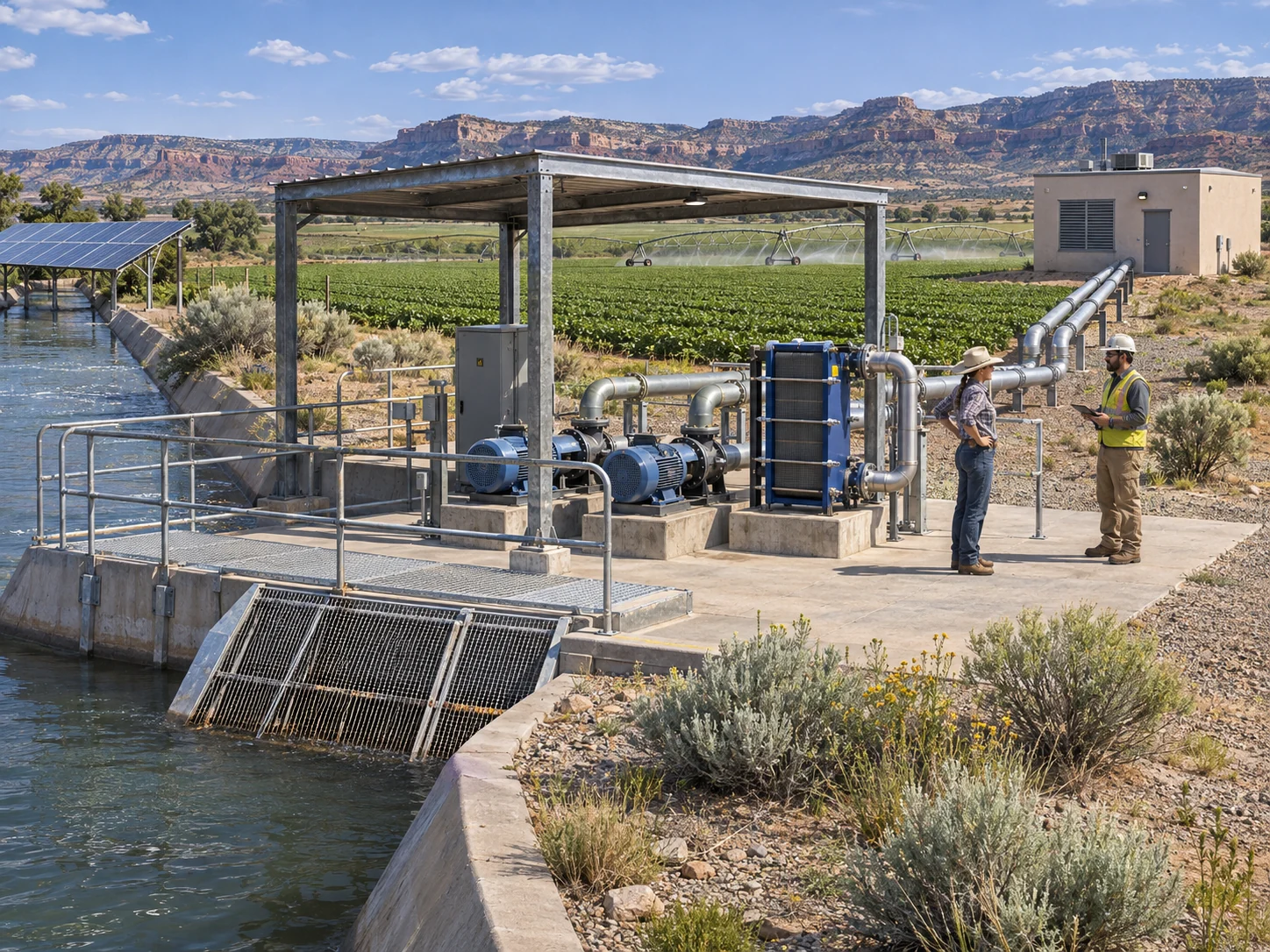
A farm operator and utility technician stand beside an irrigation service station, with isolated heat-exchange equipment, a canal and productive fields.
Cool the infrastructure on the way to the crops.

WaterCo · Irrigation cooling and water services

Let irrigation water do a cooling job on its way to the farm.

Water already scheduled for crops passes through an isolated heat-exchange interface, accepts an agreed amount of heat, then continues toward the fields. Compute coolant stays in its own circuit. That flow can reduce conventional cooling and separate evaporative demand for the share of heat it accepts.

Keep farming. Get paid for another service.

HeatCo pays participating growers for measured heat acceptance through the agreed district program. WaterCo delivers the water and operates assigned canal works. Contracts protect agricultural quantity, timing, quality and crop-safe temperatures.

Better irrigation, lower operating burdens.

Canal-cover solar generates power and shades water to reduce evaporation. Agreed canal repairs, controls and regulating storage can improve delivery and reduce maintenance. Contracted savings pass through to growers. Farmers keep their water rights; a cooling agreement does not purchase those rights.

Conservation that rewards production.

A participating grower who verifies eligible savings keeps the avoided volumetric water charge and receives a matching town payment. The program requires continued agricultural production and legally available net savings after return-flow effects. Fallowing does not qualify as efficiency.

Crop conditions govern the cooling. Start with measured trials, application-point sensors, comparison plots and cooler-water blending. The proposed five-degree Fahrenheit delivery lift is a trial basis, not a universal crop-safe promise. When flow or temperatures cannot accept heat, HeatCo uses other cooling routes.

Farmer protection and community water

The program proposes first-year protection for crop losses caused by project warming or project-caused irrigation interruption; coverage, limits and premiums still need to be secured. Enrollment, conservation verification and water transfers follow the agricultural administrator and legally responsible water authority.

WaterCo also provides bulk delivery and operates drinking-water, wastewater and reclaimed-water systems. The Public District owns accepted municipal fixed assets; WaterCo is the contracted operator. Reclaimed water serves local landscaping through its separate network. Irrigation cooling returns do not enter drinking-water or swimming-water systems.

Responsibilities and planning basis

The proposed launch program is $30 million: $20 million of agreed water-system improvements plus $10 million over five years for eligible repairs and conservation administration. It is separate from recurring heat-acceptance payments, conservation purchases and the battery’s purchased fill. None is an awarded grant or executed farmer offer.

Role
Proposed bulk-water, canal, municipal-water, wastewater, and reclaimed-water services company.
Owns or operates
Assigned bulk delivery, canal improvements and canal PV; treatment, drinking-water, wastewater and reclaimed-water services. Operates the public common lower/agricultural reservoir and adopted municipal assets under future contracts; public ownership remains separate.
Receives
Water within validated rights and quality limits, power from PowerCo, thermal and return-service payments from HeatCo where contracted, and public or user funding.
Provides
Water delivery and treatment, canal and municipal service, reclaimed-water service, and the water-side interface to irrigation districts and participating farmers.
Community value
Modernizes shared water infrastructure and connects industrial demand to better regional service without transferring agricultural rights by implication.
Key interfaces
HeatCo, PowerCo, irrigation districts, participating farmers, residents, businesses and the Public District.
Status and open questions
Current planning package; rights, volumes, public-asset ownership, canal authority, tariffs, and public contracts remain unresolved.
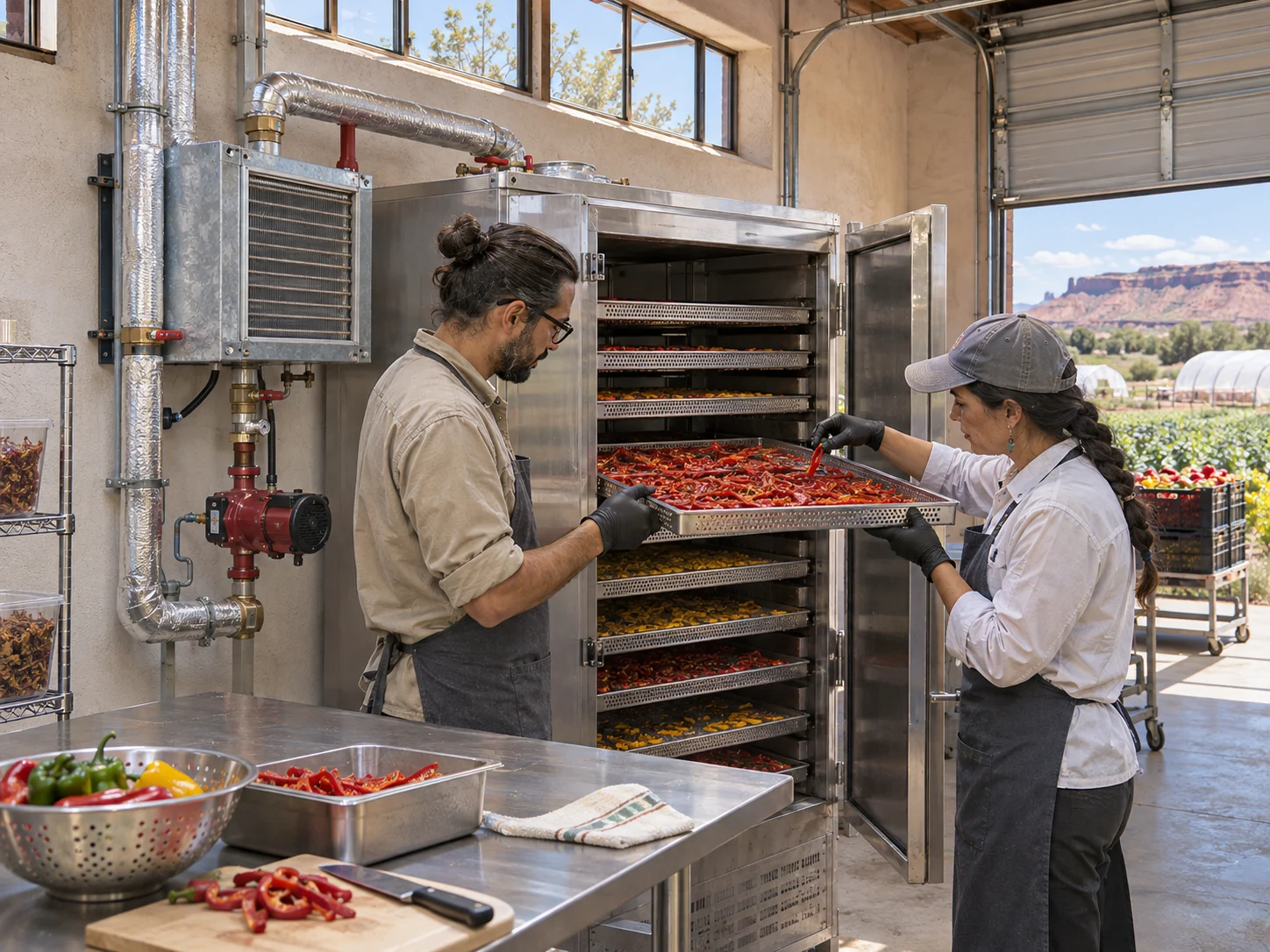
Workers load produce into a food dryer beside a closed hot-water heating interface in a Southwest processing workshop.
Useful thermal service helps keep more crop value here.

HeatCo · Cooling and productive heat

Turn a cooling obligation into useful local services.

Compute operators pay to remove heat. HeatCo looks for productive places to use that heat before rejecting what remains: compatible preheating, agricultural processing, building heat when needed and measured exchange into scheduled irrigation.

Connect heat customers by temperature.

Low-grade compute heat can warm a suitably colder stream. Hotter drying, process water and manufacturing need additional energy or a hotter source. HeatCo coordinates those interfaces so useful recovery reduces cooling at the source and energy purchases at the receiving business.

Different heat grades. Clear jobs.

Low-grade compute recovery

Preheat and agricultural interfaces

Use actual return temperatures for compatible preheat, direct-use warmth and controlled irrigation exchange. Agricultural schedules and crop limits set when that outlet is available.

Additional energy and hotter sources

Process heat and thermal uplift

Solar or industrial processes add the energy needed for higher temperatures. Qualified industrial recovery can serve warm-process duties or PowerCo feedwater preheat. Every uplift needs an energy source, equipment and a viable customer.

Industry can use and supply heat.

A manufacturer may buy preheated water or material, add its own process energy, then export suitable residual heat through another interface. Glass, aluminum, food processing and later high-tech production are potential partners. Temperature, available heat and operating hours must match.

Keep cooling when irrigation cannot help.

When irrigation pauses, suitable process customers and justified thermal uplift can take the heat they can use. Regulating storage and qualified reservoir buffering can shift timing. Dry cooling and emergency wet rejection provide independent outlets when farm flow, weather, customers or storage cannot accept heat. Remaining equipment is sited and engineered away from homes.

Businesses keep control of their processes. HeatCo owns its thermal network and receiving interfaces. Manufacturers and food businesses retain their refrigeration compressors, refrigerant and cold rooms. Processors participate through measured cooling, heat-supply or thermal-service agreements. All industrial, crop, drinking and public-contact water circuits stay appropriately isolated.

Responsibilities and planning basis

South’s hot-water study separates compute preheat from qualified hotter industrial supply and PowerCo’s steam machinery. HeatCo does not turn low-temperature waste heat directly into a high-temperature furnace, and useful demand never substitutes for independent final rejection.

Role
Proposed compute-cooling and thermal-services company.
Owns or operates
Compute cooling and hot-side heat removal, isolated heat-recovery interfaces, compatible direct-use heating, hot water, qualified industrial thermal service, and dry/emergency wet final rejection.
Receives
Compute heat, power, water services, customer service payments, and qualified agricultural or industrial heat demand.
Provides
Cooling service, priced thermal services, and measured heat to qualified water, agricultural, industrial, or public interfaces.
Community value
Converts part of a cooling obligation into useful services and farmer payments while retaining independent rejection when demand or water conditions cannot accept heat.
Key interfaces
Compute and industrial customers, PowerCo, WaterCo, participating farmers, LandCo and the Public District.
Status and open questions
Current planning package; source temperature, procurement, weather/outage capacity, agricultural acceptance, and interface pricing require validation.
People use a shaded solar-canopy plaza beside shops and a protected public lagoon.
Public places and public responsibilities.

Public District · A separate public owner

Make the benefits public—and the obligations accountable.

The Public District is the proposed public owner and service purchaser, separate from Development and the utility companies. It holds accepted civic assets, funds public obligations and contracts for defined services under the chosen jurisdiction’s law.

Shade that earns its place.

Solar geodes put photovoltaic power above civic spaces while giving people shade below. Gardens, seating and a protected swimming lagoon make the town useful outside the home—even in a hot climate. Reclaimed water supports local landscaping through a separate system.

Partial recovery, measured honestly.

Shade can reduce evaporation. Collection surfaces and gutters on the geodes and canal solar can also recover droplets and any condensation that forms. Mesh does not collect invisible vapor without condensation. Weather, ventilation and water quality limit recovery; no capture percentage is established.

Public ownership. Contracted operation.

The current plan assigns the common lower reservoir and accepted municipal water, sewer and reuse fixed assets to the public owner. WaterCo operates them under enforceable contracts. Public ownership does not require the government to run every pump—or give a private operator public powers.

Recurring benefits need recurring funding. Publish budgets, contracts, service standards and renewal obligations. Residents participate through public budget review, records access and elections where applicable. Developer/anchor contributions fund proposed initial works; public service capacity grows with secured recurring revenue and occupied neighborhoods.

Civic water, safe operation and public formation

Necessary freshwater replenishment can descend through a landscaped cascade into a constant-level public lagoon before controlled passage toward protected raw-water storage. The swimming area is separated from hydro drawdown and strong turbine currents. Monitoring and treatment obligations remain real operating work; industrial or agricultural cooling return is not routed through the lagoon.

Public formation follows the selected state and host jurisdiction. Any later municipal transition needs lawful processes, asset acceptance and funded service agreements. A planning proposal does not incorporate a town, authorize taxes or transfer utility debt to residents.

Responsibilities and planning basis

Use the current financial reference for donated public assets and contracted private operation. Older civic tax examples are jurisdiction-specific scenarios; they are not adopted rates, committed revenue or a promise that services are already funded. Evaporation suppression and actual collected water are different effects and must be counted separately.

Role
Proposed separate public-purpose entity for public works, administration, civic assets, public-service contracting, and accountable transition.
Owns or operates
Public assets and services accepted under eventual legal authority and agreements. The current planning allocation includes the common lower/agricultural reservoir; WaterCo operates it under contract and PowerCo owns incremental hydro works.
Receives
Public revenues, launch funding, service agreements, transferred public assets, and public requirements through lawful processes.
Provides
Public works, civic services, transparent contracts and budgets, and accountable public operation.
Community value
Keeps elections, public records, taxes, public assets, and service obligations outside private-company control.
Key interfaces
Residents, the host jurisdiction, Development, LandCo, utilities, service providers and a future elected public body.
Status and open questions
Proposed boundary; it is not yet an incorporated municipality, approved taxing authority, or commitment of public funding.
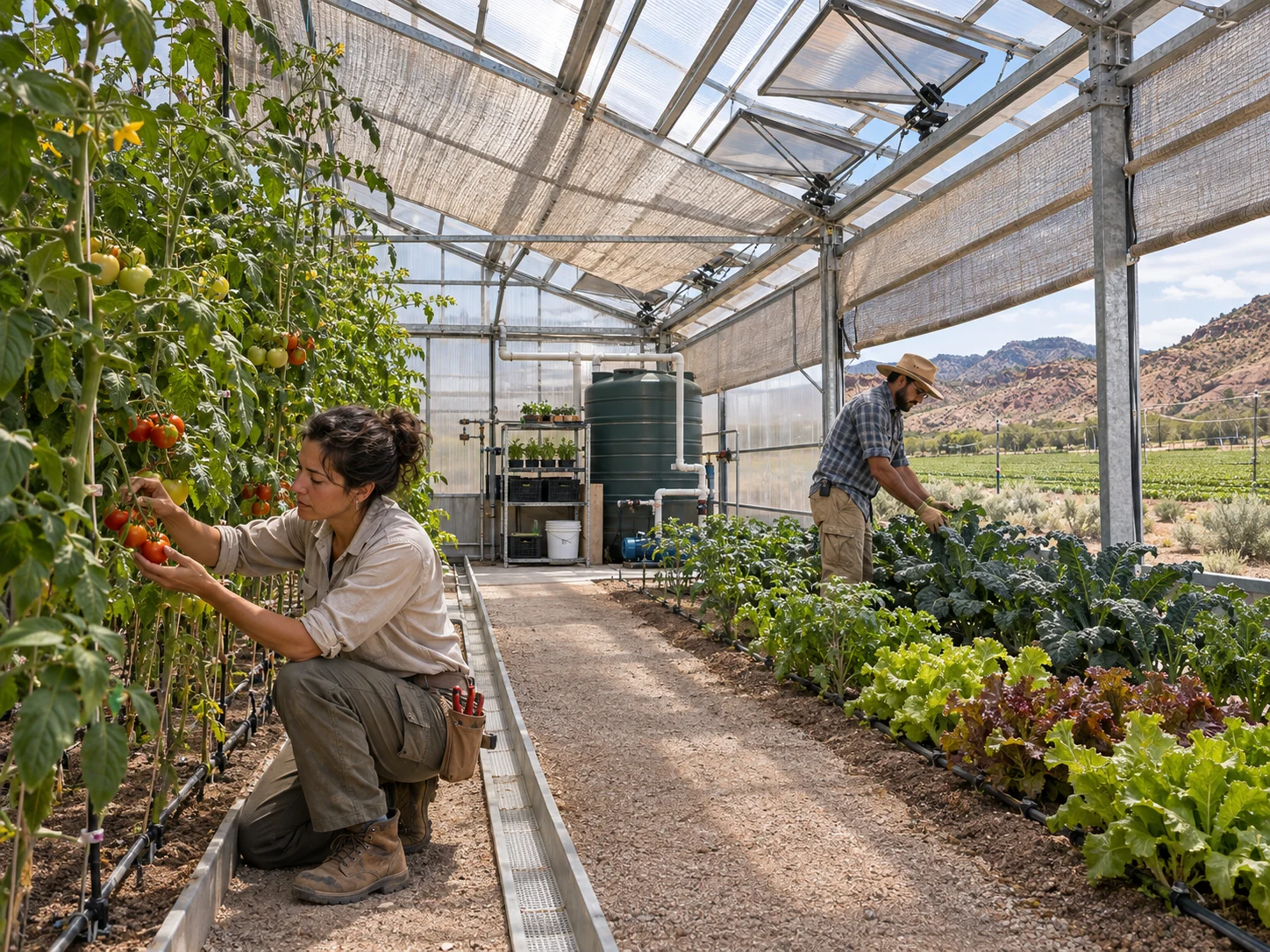
Growers tend crops under ventilated greenhouse shade with drip irrigation and controlled water delivery.

Working farms, more opportunity

Keep the land productive. Keep more of the harvest’s value.

Conservation should strengthen farming. More controlled growing—such as greenhouses with drip irrigation, suitable shade and water recovery—can keep land productive while reducing avoidable water loss. In South, greenhouse cooling is a real design requirement; crop, climate and water performance still need to be proved.

Then keep the next steps nearby: drying, packing, cold storage and distribution. Shared services and serviced space give farmers and local businesses a route to higher-value products. Compatible thermal recovery can help; customer-owned refrigeration and market access matter too.

Growing, processing, logistics and maintenance can broaden the job market beyond construction. Complementary seasonal work needs actual crop calendars, skills and training—not an assumed year-round job for every worker.

See the farmer partnership ↗
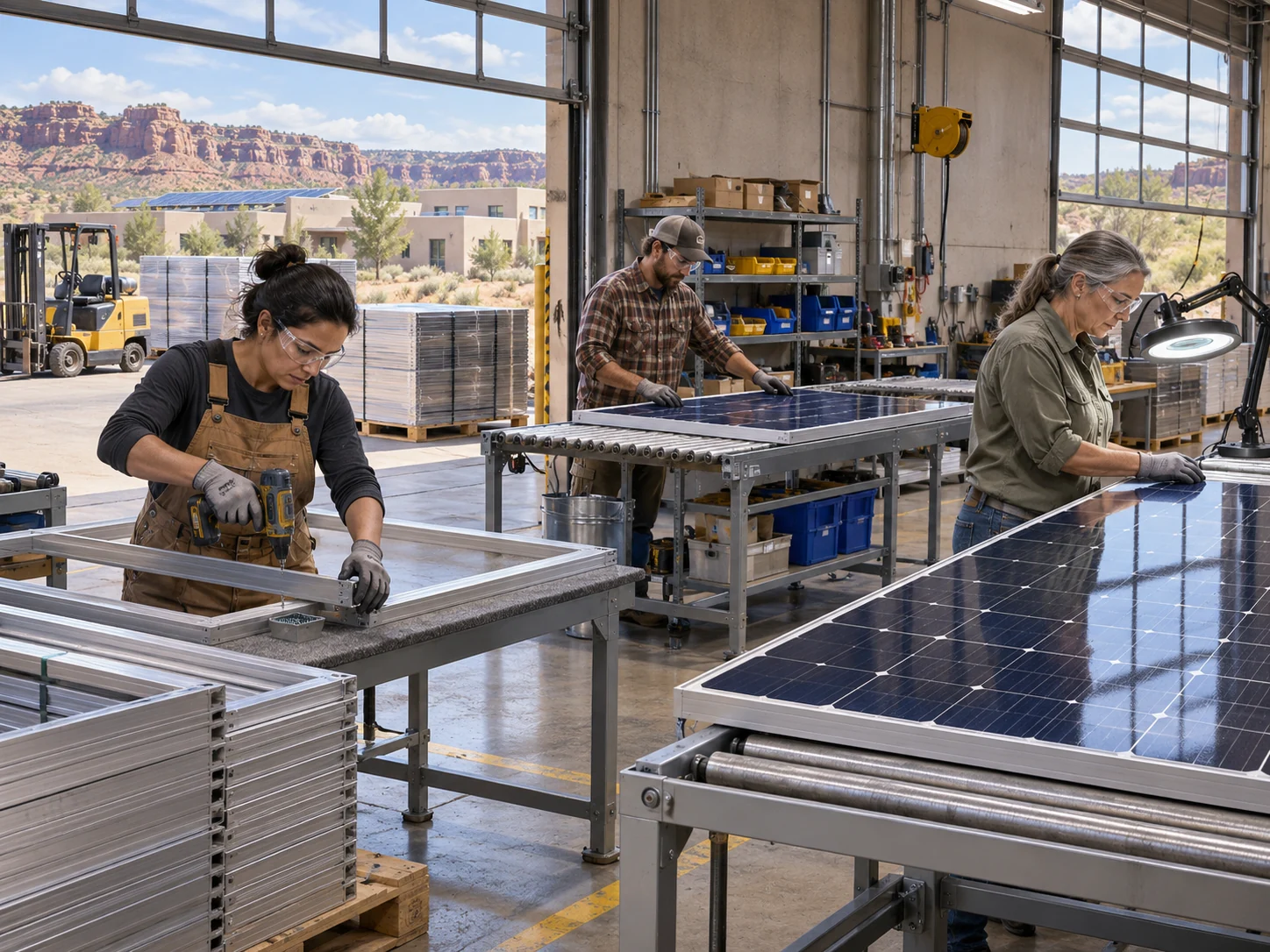
Workers assemble aluminum-framed solar panels and inspect finished modules in a practical Southwest factory.

Build the town with what the town makes

Make the panels. Build the skills. Keep the work here.

A town buying solar panels, frames, mounting structures and building products can become an early customer for local manufacturers. Start with commercially viable module assembly, aluminum processing and fabrication, and suitable glass supply. The same businesses can serve regional customers and later replacements.

Dependable electricity, serviced industrial land, freight access and qualified workers support that ambition. Useful preheat and recoverable process heat add connections where their temperatures and economics work. Factory partners, orders and complete investment cases still need to be secured.

From assembly to high-tech industry

Assembly can begin with purchased cells, glass and aluminum inputs. Local high-quality silica is a site and supply-chain question, not a confirmed resource; solar-grade silicon also needs substantial purification and qualified production.

Solar Forge explores later silicon ingots, wafers, cells and solar-furnace-assisted processes. Its shared high-temperature network is an optional research and investment program, separate from the first factories and PowerCo’s solar lift. Conventional electrical service remains the operating fallback. No utility budget already funds those factories.

Homes, shops and shaded sidewalks form a human-scale Southwest neighborhood.

A place people choose

Build a community around the opportunity.

Homes near lasting work. Independent shops with local customers. Shaded civic spaces, public gardens and places to meet. Plan the industrial footprint, freight and cooling equipment before the neighborhoods arrive.

A new community gives people somewhere to move by choice, while farms and surrounding towns share in infrastructure, business activity and employment. Housing and services grow with proven demand; public benefits come with named owners and funded operating duties.

Explore the civic spaces and public responsibilities ↗

Ownership and accountability

Local people should share in what they help build.

The intended model gives residents, producers and local businesses first access to eligible ownership opportunities. Cooperative participation can keep business value local. Each company must publish eligibility, pricing, governance and financing terms before an offering; South has no universal ownership percentage or executed resident offer.

Private shares are one form of participation. Farmer service agreements, local supply contracts and public ownership of civic assets are others. Public budgets and oversight keep public powers and obligations separate from the companies delivering services.

Start with a pilot, work with the people already here, and prove the operating and community bargain before expanding.

Build a stronger southern economy

Bring the farmers, industry and community into the design.

Connect with us